Drains: discover the most used in the industry
For maximum efficiency of the installations, it is ideal that the delivery of steam and compressed air is as complete as possible. For that, there are the purgers, equipment used precisely to eliminate condensate from steam and compressed air lines.
It is common for condensate to appear in compressed air and steam lines., as moisture in the air or steam condenses. If not removed properly, These condensates can damage equipment and harm the entire process.
What are traps?
Steam traps are equipment with technological capacity to differentiate live steam from condensate, separate them and also purge this condensate, air and non-condensable gases.
They are robust pieces capable of working in the most adverse situations withstanding high temperatures, water hammer, high pressures, movement and vibration.
What is the function of steam traps??
The traps act, to increase the efficiency of steam systems through three main factors:
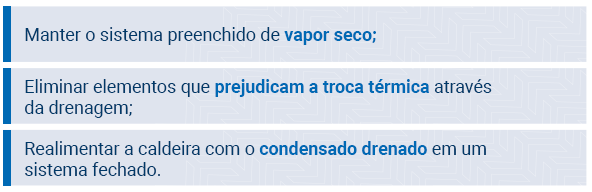
In addition to the above advantages, the different types of steam traps adjust according to the flow of condensates and fluids, avoiding accumulations and leaks in adverse situations that the fixed opening of a valve “standard” would not support.
What are condensates and how are they formed?
In a heating system, when vapor changes from a gaseous state to a liquid, a liquid called condensate is formed. Condensate is the result after the steam has transferred a portion of its thermal energy known as latent heat to the product, line or equipment being heated.
For example, in an industrial heating system, when the steam energy has already been used and its latent heat has been supplied, part of this vapor passes to the liquid state and, because it does not have the same ideal properties that it had in its gaseous state, becomes a burden to be dealt with.
Outside of heating systems, the loss of steam energy through contact with the piping and the humidity in the air itself, they produce condensate.
Compressed air condensate is a by-product of all compressors.. It is a mixture of environmental hydrocarbons, compressor lubricant with ambient humidity and particles that have been concentrated and removed from the air stream by dryers and filters.
In addition to not presenting the ideal properties, condensate – and its consequent accumulation – can lead to several other recurring problems in the industry, as: internal corrosion of pipes, water hammer and line flooding.
Drainage deficiency
Drainage deficiency occurs when, for some reason, the condensate, air or CO2 is not drained properly, causing flooding in the system and loss of steam system efficiency.
Steam leakage into the condensate return line is also a drainage deficiency, as there is a waste of steam and consequently energy.
Some symptoms that we can find in deficient systems are:
- Morno purger / cold;
- Water hammer;
- By-pass aberto;
- Equipment takes time or does not reach temperature;
- Internal oxidation of the condensate piping (air and CO2 elimination).
Some causes of flooding:
- Increased counterpressure;
- Sizing error;
- Malfunction or breakage of the traps (clogging, dirt or breakage).
Most used types of traps
To deliver steam and compressed air as completely as possible and avoid any drainage deficiencies, different types of traps were designed with different construction principles, application modes and purposes. Below, we will mention the most important and used in the industrial market today.
Thermodynamic trap
Thermodynamic traps are low-cost options for draining condensate in steam distribution lines with up to 42 pressure bar, working by distinguishing components through speed (faster vapor and slower liquid).
It is designed with three outlet holes and offers stable disc operation, what associated with hardening thirst, guarantees longer lifespan of the trap. They are recommended for situations where it is necessary to eliminate condensate from steam distribution lines.
Advantages:
- Reduced size and weight;
- Can be installed in any position;
- One seat size for all pressures;
- Water hammer resistant;
- Relatively low price.
Thermodynamic trap with universal connector
Using the same technology as the previous trap, the thermodynamic trap with universal connector is designed with a universal connector attached, enabling the removal of the trap without the need for intervention in the piping.
Two screws secure the trap to the connector block that, in turn, remains installed in the piping without the need for flanges or unions. Ideal for draining condensate in saturated steam distribution lines with up to 42 pressure bar. They are recommended for situations where frequent maintenance is necessary due to low risk, as there is no intervention in the piping to remove it.
Advantages:
- Enables the removal of the trap without the need for intervention in the piping (easy handling and maintenance);
- One seat size for all pressures;
- Water hammer resistant.
Thermostatic drain
Simple and robust, The thermostatic steam trap is an excellent solution for draining condensate in small equipment with up to 42 pressure bar.
It works with the temperature difference of the components for separation. The thermostatic activation occurs through a bi-metallic device that guarantees efficiency and durability.
Advantages:
- Compact size;
- At the beginning of processes, has a greater capacity to drain condensate and gases;
- Water hammer resistant.
Buoy purge
The line of float traps is an excellent cost-benefit option for draining condensate in low pressure steam heating equipment such as heat exchangers, streamers, shirts, etc. It allows easy and low-cost maintenance and comes standard with a bi-metallic thermostatic air eliminator that guarantees efficiency and durability.
This type of trap works according to the level of condensate present in the line, regulating the drainage intensity continuously.
Advantages:
- Quickly discharges large quantities of air and gases through the thermostatic element;
- Does not accumulate condensate (modulating);
- Large condensate discharge capacity;
- Condensate seal preventing the passage of live vapor into the condensate.
Inverted bucket drainer
Inverted bucket traps allow efficient drainage of condensate to application in all types of equipment that use steam. How they operate efficiently for long periods, traps enable significant energy savings, in addition to reducing labor and replacement costs.
It features a lever system that multiplies the force exerted by the bucket to open the valve against the system pressure. The mechanism is floating and has no fixed joints that could cause wear or friction.
Advantages:
- Long service life;
- air eliminator, CO2 and other non-condensable gases;
- Corrosion and dirt resistant;
- Water hammer resistant,
Learn more about traps
Today in the industry, The importance of steam traps in steam distribution lines and in equipment that uses steam and compressed air is unquestionable.
KLINGER Brazil – for more than 50 present in the country for years – offers and specifies the most diverse types of steam traps, in order to find in your portfolio the perfect solution for the need presented.
Here at our website, you have access to different types, application sites and also information on how to apply them in your industry and about the sealing sector, fluid monitoring and control.
And no Linkedin da KLINGER Brazil, It is possible to follow news in the segment, more information about products, What type of material to use? and other content under control, fluid monitoring and sealing.