PTFE for sealing and its variations
PTFE is used in several situations as a coating for household items, dental prosthetics, artificial bones and, it is clear, em industrial applications for sealing of fluids.
PTFE materials have a difference compared to other elastomers: resist degradation and changes in its physical properties, thus allowing a long product life.
They can also be stored indefinitely and can be exposed to the elements, in addition to being resistant to the actions of UV rays.
Find out more about its properties below.
What is PTFE?
O PTFE (polytetrafluoroethylene) – better known by the trade name Teflon®, from the company Duppont – was accidentally created in 1938 Roy Plunkett chemical hair while doing experiments with gases for refrigeration. Roy noticed the appearance of a white powder in the cylinder that contained the gas..
On the occasion, Roy had another objective in the research and could have discarded the substance. If he had done this, PTFE would not exist.
Types of PTFE for industrial use
In the industrial sealing segment, There are three types of polytetrafluoroethylene: virgin, loaded and expanded, which we will discuss below.
Virgin PTFE:
 It consists of PTFE basic formulation without additives and without expansion processes. It has high chemical resistance, but also with high levels of flow and deformation.
Due to the deformation of Virgin PTFE, its joints must be applied at temperatures close to ambient temperatures, at low pressures and in non-critical applications (non-hazardous fluids).
With thinner thicknesses (0,5 mm), This variation works as a great material to use as an envelope for gaskets and “o” rings., then creates a chemical protection barrier over the gasket hydraulic cardboard or elastomer.
Loaded PTFE:
 Filled PTFE (microspheres, silica and barium) is a formulation that mixes mineral additives in the composition of virgin PTFE, ensuring that each product is suitable for a specific type of application (acid, alkali, low torque).
This solution PTFE with additive of other substances was introduced into the industry in the 50 in order to improve the properties of the virgin material mentioned above. An everyday example is Tefal (Teflon + Aluminum) as a non-stick coating.
Already for the sealing industry, PTFE received mineral fillers that delay, but they don't stop, the unwanted flow that occurs in the virgin type.
Expanded PTFE:
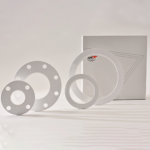 The evolution of PTFE products for sealing reaches its peak with the expanded type, created by the company W.L. gore on 1969.
O expanded PTFE and manufactured due to the process of pulling the material in one or more directions, increasing its porosity, making it soft.
However, the material has the same composition as pure, but with improved sealing properties and without losing the chemical resistance inherent to the polymer.
The provision of a certain softness and porosity ensured that the material was better suited to basic sealing needs., which are the compressibility and recovery of the material. Such characteristics ensure that the seal is able to be compressed and accommodate flange imperfections through crushing pressure..
As expanded PTFE does not have the deformation inherent to other types, he is capable of maintaining a pressure resulting (tightening assembly torque) for longer than any other material.
It can be expanded unidirectionally (image below left) or multidirectional (image below right).
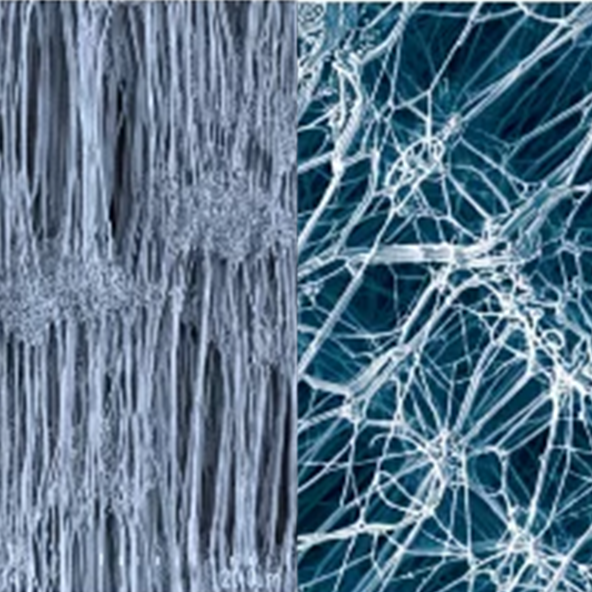 Expanded PTFE can be found modified in sheets and gaskets. seal what offer compatibility with almost all chemicals, with the exception only of elemental fluorine and molten alkali metals.
The high melting point of this material allows it to be applied at temperatures that can have peaks of up to 315ºC. (depending on other factors).
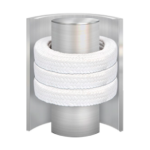 PTFE can also be found in gaskets.
Due to its high chemical resistance of this material, the gaskets produced with it can be used in almost all industry applications and have excellent durability.
The pure PTFE gasket applied in the pharmaceutical and food industries stands out, in which there can be no contamination of the product (image above).
With the addition of graphite in the gaskets, increases resistance to friction and allows use at higher speeds.
For example, the GFO high performance gasket is capable of increasing the operating time of equipment by many times, as its amount of graphite and braid continuity provide excellent heat dissipation and lubrication for a long period compared to gaskets available on the market.
Learn more about sealing
PTFE is a type of substance that implements other materials used in sealing, but which can also be used alone. Here at our website, you have access to different types, application sites and also information on how to apply them in your industry and about the sealing sector.
No Linkedin da KLINGER Brazil, It is possible to follow news in the segment, more information about products, What type of material to use? and other content under control, fluid monitoring and sealing.